
What goes into making good stucco?
When we look at a finished wall, the first things we notice are its texture, uniformity, and finish. However, behind that result lies a series of variables that begin long before the material is applied. A stucco may provide an excellent finish in the laboratory but present problems once it reaches the job site: sagging, difficulty spreading, uneven absorption, cracking, loss of adhesion, or variations in the finish.
Therefore, developing a good stucco requires understanding not only the materials that make it up, but also how they interact with one another and how they will perform on different substrates and under different application conditions.
The first challenge lies in the substrate
Not all wallsbehave the same way. A cinder block, a brick, mortar, cellular concrete, or a drywall panel each have different levels of absorption, porosity, and surface texture.
When the substrate absorbs water quickly, the mixture may lose its workability prematurely, affecting the hydration process and the material's performance.
Therefore, before focusing solely on the product, the formulator should consider:
- Substrate Type and Absorption
- Application Thickness
- Application Method
- Environmental Conditions
- Expected finish
The formulation must be tailored to the wall it will actually encounter.
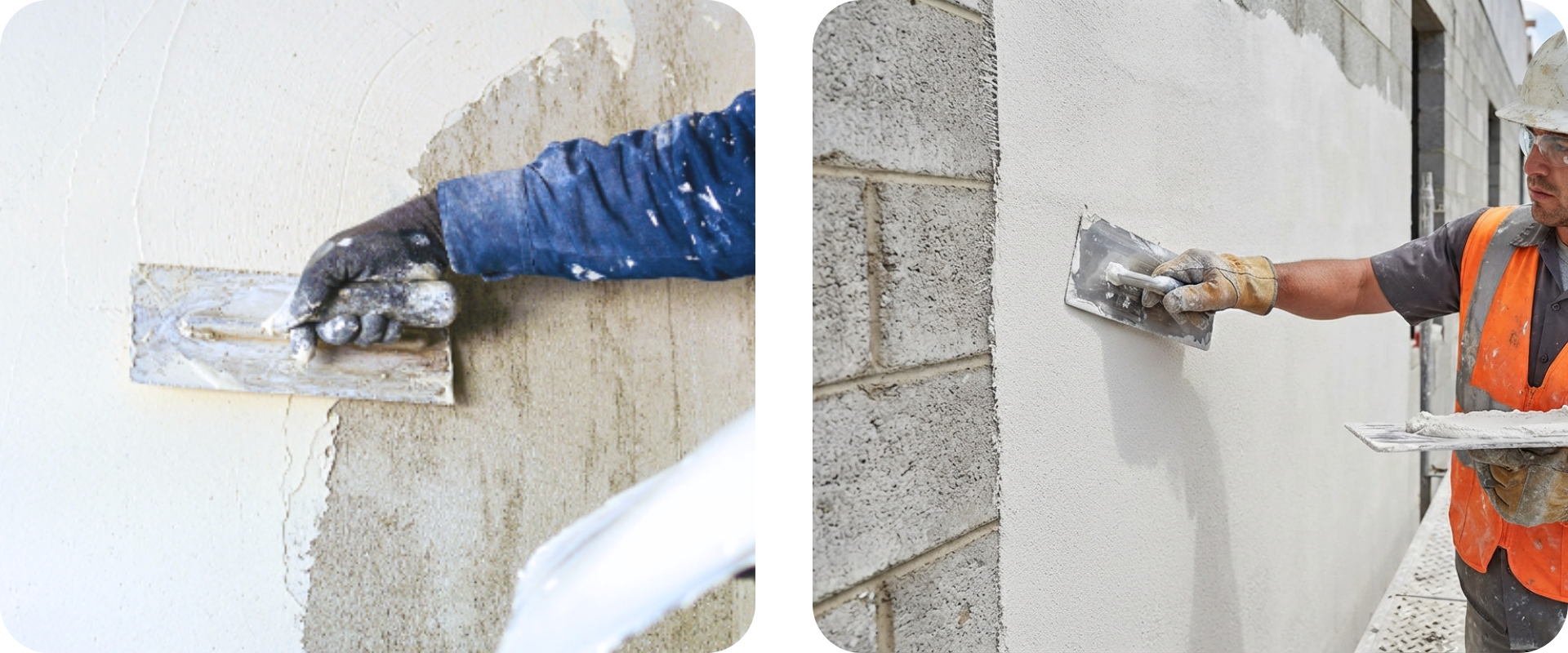
Water Retention: Managing What We Can't See
During application, water plays a key role in the behavior of the stucco. If water is lost too quickly, it can affect workability and alter the development of the material’s properties. Controlling water retention and rheological properties helps maintain a more stable mixture during application.
Cellulose ethers can help:
- Control water retention.
- Adjust the viscosity and rheology.
- Improve workability.
- Promote more consistent implementation.
But there is one important point to note: higher viscosity does not necessarily mean better performance. Excessive dosage can make the mixture harder to spread, alter its texture, or affect its behavior.
The goal is to find the right level for the required application.
Why does stucco peel off?
In vertical applications, this is one of the most obvious problems. The stucco needs to be fluid enough to spread easily, but it must also maintain the cohesion and stability necessary to adhere to the wall.
When there is an imbalance:
Too much fluidity → can reduce stability and increase the risk of the glider stalling.
Excessive viscosity → can make spreading difficult and affect productivity.
Low cohesion → may compromise the stability of the mixture during application.
Therefore, controlling rheology does not simply mean increasing viscosity. It means designing the mixture's behavior so that it performs correctly during application.
Adhesion: More Than Just “Sticking”
A stucco must form an adequate bond with the substrate and maintain that bond throughout its service life.
Redispersible polymers can help improve properties such as:
- Adherence.
- Cohesion.
- Flexibility.
- The system's resistance to certain operating conditions.
However, the final adhesion also depends on factors such as the type of substrate, surface preparation, formulation, and application conditions. Therefore, once again, there is no single factor responsible for the result.
What about the cracks?
A crack does not necessarily have a single cause. The behavior in response to cracking may be related to variables such as:
- Shrinkage due to drying.
- Water content.
- Applied thickness.
- Substrate Characteristics.
- Environmental conditions.
- Adherence.
- Compatibility among components.
Therefore, attributing crack control to a single additive oversimplifies a phenomenon that depends on the overall behavior of the system.
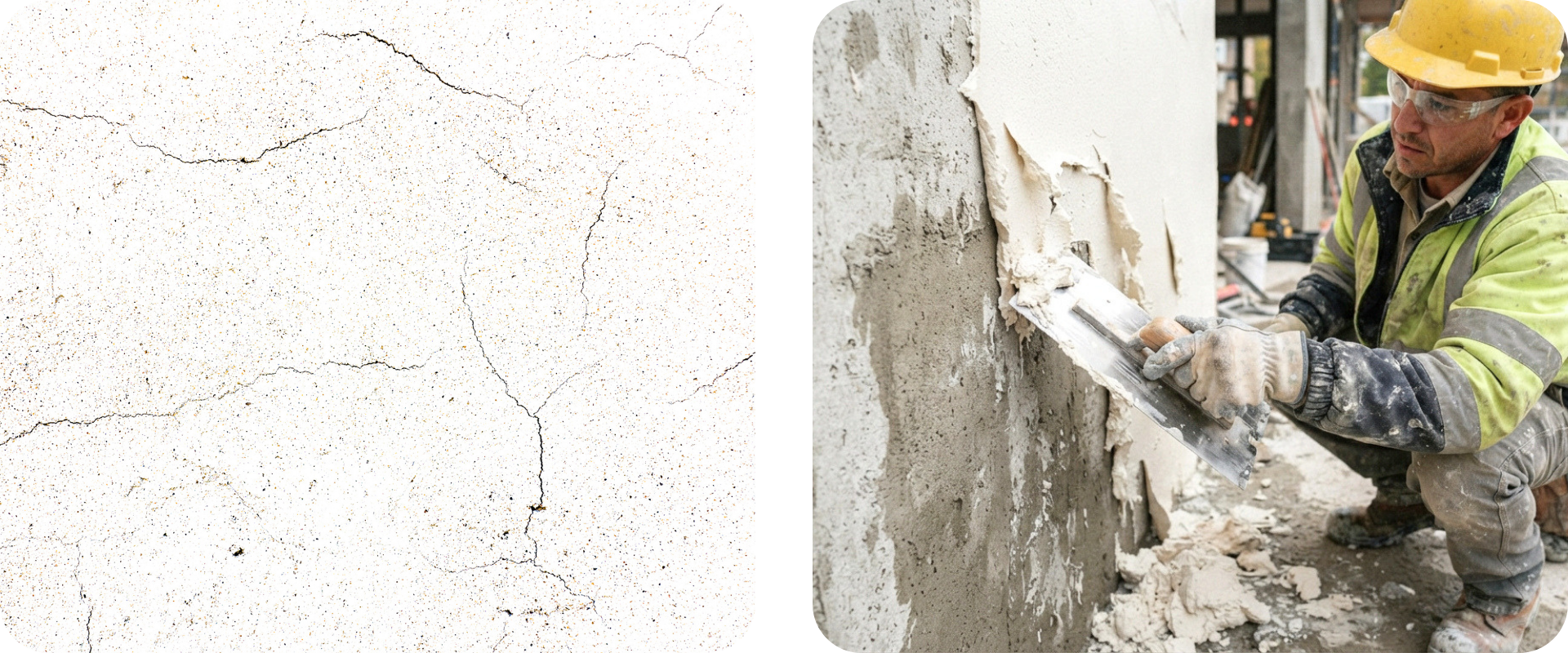
The finish is also formulated
The final appearance of stucco does not depend solely on its texture or the pigment used. The consistency of the mixture, the absorbency of the substrate, the application method, and drying conditions can all affect the uniformity of the finish. When developing colored stuccos, the selection and proper dispersion of pigments must be integrated with the rest of the formulation to ensure a uniform and consistent appearance across batches.
The Right Technology for the Right Problem
This is where additives truly prove their worth. It’s not about adding more components, but rather about selecting the right technology to address a specific need and achieve the required performance in each application.
For example:
- Water retention and rheology control: cellulose ethers help regulate the water content, viscosity, and workability of the mixture.
- Adhesion and cohesion: Redispersible polymers can help improve the adhesion, cohesion, and flexibility of the system.
- Color development: Pigments enable color development and help ensure a consistent appearance across applications and batches.
- Adjusting Specific Properties: Other functional additives make it possible to modify certain characteristics of the mixture to meet the product's requirements.
However, the result does not depend on a single component. It is the interaction between the technologies, the dosage, and the actual application conditions that determines the final behavior of the stucco.
The right technology isn't the one with the most features, but the one that addresses the right need.
There is no such thing as a universal stucco
A competitive stucco must meet the specific conditions for which it was designed. The formulator must strike a balance between:
Applicability + stability + adhesion + finish + durability + target cost
The goal is not to maximize a single property, but to develop a solution that is consistent in production, efficient in application, and capable of meeting market demands.
The Role of Formulation
Developing a stucco goes far beyond simply creating a mixture that can be applied to a wall. It means understanding the substrate, anticipating application conditions, selecting the appropriate technologies, and determining the correct mix ratios to achieve the desired performance.
At Treechem, we work with building materials manufacturers to select and optimize specialized technologies and additives, helping to translate specific application requirements into technically viable formulation solutions.
The finish is what we see. The technology is behind the scenes.
Learn the key formulation principles for developing grouts with superior performance, consistency, and durability for various construction applications.

The open time of ceramic adhesives refers to the period during which the material retains its ability to wet the substrate and develop effective adhesion.
.png)
Did you know that 65% of structural concrete deterioration is directly related to corrosion caused by moisture?

Celluloses are high molecular weight polysaccharides. They are transformed through chemical reactions into cellulose ethers, key additives used in multiple industries.
Polyamine compounds are key cationic organic coagulants in the treatment of industrial and municipal wastewater.
.png)
The most demanding manufacturers are already using them. Increase the durability of your mortars and concretes.